I made quite a fuss when I turned 29; I joked that my life was flashing before my eyes. Those who had lived already to the age of 29 twice or thrice certainly thought I was overreacting! They assured me that 30 is still quite young. I think I may have believed them.
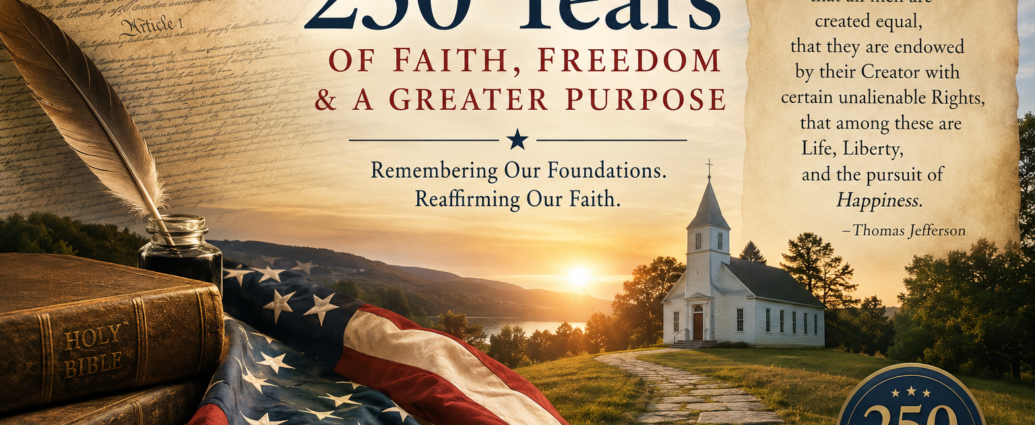
On July 4, 2026, our country will turn 250 years old. That’s a big number! Yet, just like my turning 30, the United States of America really isn’t as old as it may seem. Sure, we are older than the Federal Republic of Germany (formed after WWII). But older than the Holy Roman Empire, which became modern Germany? By no means. Older than India? Negatory. China? Not by a long shot. Our nation is still a youthful sprout nestled among the greybeards of the world’s great civilizations and societies.
It is not my intention during Pastor’s Corner to violate our longstanding tradition of separation between church and state. Yet every church, every Christian, has a context—and mine is the US of A. We have a fascinating history, and the US has undoubtedly played a significant role on the world’s stage. Perhaps nothing is more interesting than the story of our founding, and the ideas that went into it—especially the ones inspired by the Judeo-Christian tradition.
I recall a conversation I had with a British woman during my trip to Munich. She noted the uniqueness of America’s founding, the fact that such a moment of coming together to form the groundwork of a society is almost unheard of. She’s right. Most societies grow naturally. Great Britain, as an example, emerged slowly over time. The Anglo-Saxons consolidated into one people—the English—only to be conquered by the Normans, who gradually assimilated. King John signed the Magna Carta in 1215, a document which promised protection of church rights, protections against illegal imprisonments, and limitations to the King’s rights to levy taxes from his nobles. Sound familiar?
John Wesley’s Britain of the 18th century, with its bicameral Parliament, limited monarchy, and trial-by-jury system (a legacy of Anglo-Saxon England), grew slowly and organically from the original society of Germanic tribes which migrated to the island in the 5th century AD. That is how it goes for nearly every major civilization: the Holy Roman Empire becomes Germany, the Indus valley civilization becomes India, Kiev Russ becomes Russia—and so forth. As they morph, so too does their form of governance. But they always carry over something from the last one, and the end result represents something of an archeological site—layer upon layer of law and tradition, some of them quite strange (did you know that until 1998, in order to raise a ‘point of order’ in the British House of Commons, you had to put on a top hat? True story!)
Not so with the United States. We certainly grew from the British colonies—but there was also a clean break. A demarcation. A unique moment in time in which the leaders of this burgeoning nation held its future in their hands, hands which wielded the incredible power to shape its future for generations to come.
While the revolutionaries were certainly upset about taxes—especially considering their lack of representation in Parliament—the vision of the new nation looked much farther than that. Thomas Jefferson, quoting British philosopher Thomas Locke, wrote these immortal words:
We hold these truths to be self-evident, that all men are created equal, that they are endowed by their Creator with certain unalienable Rights, that among these are Life, Liberty, and the pursuit of Happiness.
Locke had originally written “property,” rather than “happiness.” Since I believe happiness is more of a by-product of a life lived in the Lord, and not exactly an end-in-itself, I have often wished that Jefferson would have stuck with Locke’s original quote. At any rate, Jefferson went on to write,
That to secure these rights, Governments are instituted among men.
That sentence contains only ten words, 54 letters, and two punctuation marks, but don’t let it fool you! Jefferson and the founders was proposing a radically new idea. To illustrate, I’ll share a story with you about King Charles—and not the one you see on TV!
Charles I of England lost his head (not figuratively—quite literally!) in 1649 because he refused to disavow the “divine right of kings.” Throughout European history, and in other civilizations, the right to govern was believed to be given by God to the monarch. You were then considered a “subject” of the monarch, who had the “divine right” to govern you. Ergo, whatever the monarch said, went…or so Charles I thought!
For the first time in human history, a government would be instituted which recognized the rights of mankind as coming not from God via the King, but rather, from God Himself. Rather than the subjects being held accountable to a monarch governing the people with “a divine right,” the tables would be turned: the government would be held accountable to the people who had divine rights—“unalienable” rights, rights that cannot be abdicated or taken away, rights given to them by God.
As I observe our nation reaching its 250th birthday, I reflect back on America’s history. Has the country always held up to those immortal words from Jefferson? No. Counting enslaved Africans as 3/5th as a means of balancing power between the North and the South, the Trail of Tears, and the internment of Japanese American citizens during WWII certainly don’t count as premier examples of the recognition of human dignity. No government, no society, is perfect. Yet one does not have to be perfect to be a step above the alternatives.
As I read the words Jefferson wrote 250 years ago, I still find it hard not to feel goosebumps along my arm. In the words of one of my favorite interpreters of early American History, Nicholas Cage in the movie National Treasure: “people don’t talk that way anymore.”
I have had the distinct honor of visiting Arlington National Cemetery once in my lifetime. Long rows of white marble headstones testify to the fact that countless generations of Americans have believed in these founding principles, and the words which Jefferson wrote. For a country which separates church from state, we Americans are quick to answer to the call to protect and defend our God-given rights to, life, liberty, and the pursuit of happiness. They are rights which come to us not because the Declaration of Independence says so, or the Constitution says so, but because God says so.
One day, you and I will be citizens not here in America, but somewhere else. We will be citizens of a New Jerusalem, the city which John saw descending from Heaven in his vision from God. In an ironic twist of fate (for an American, at least) we will once again be subjects—with Jesus as our Lord. We will reign with him in his Kingdom. We won’t have a flag, or a 4th of July, or even a constitution. Instead, we will have all we ever need: Jesus.
Until then, as Jefferson wrote, “governments are instituted among men to secure these rights….” We will have national boundaries, national anthems, and national sports teams until the day when Jesus returns. There are many great nations on this earth, and I consider myself blessed to be a citizen of this one. I pray that the 250th birthday of our country will be a time of unity and celebration in our society. I pray that we God will grant us to see His image in each other—the very same image that grants us our unalienable rights to life, liberty, and the pursuit of happiness.
God bless you, and God bless America.
Pastor’s Logan & Jacey Zepp


